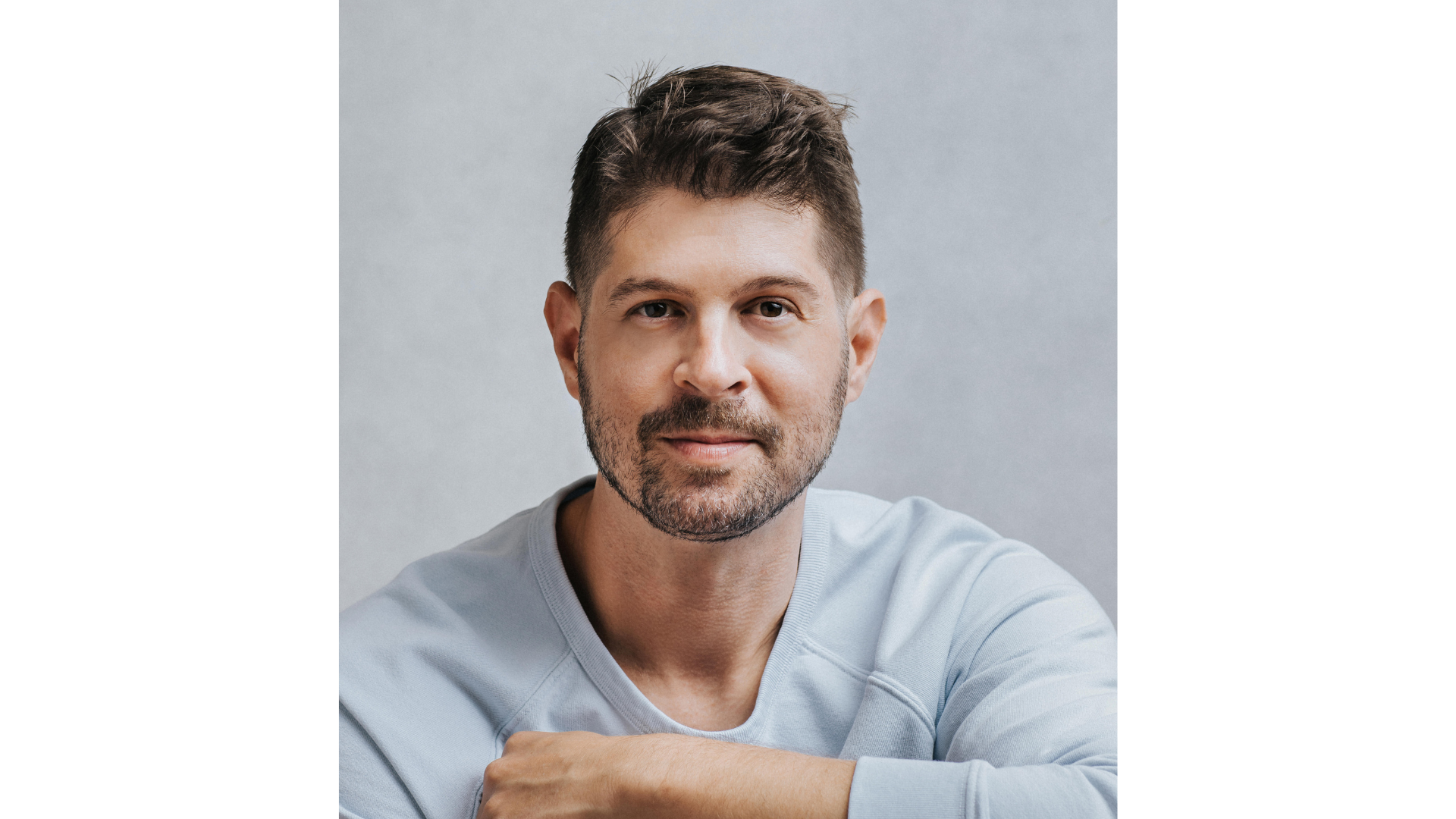
The music of composer Adam Schoenberg (b. November 15, 1980 Northampton, MA) has an ability to create “mystery and sensuality” (New York Times), and has been hailed as “stunning” (Memphis Commercial Appeal), and “open, bold, and optimistic” (Atlanta Journal-Constitution). Since graduating from The Juilliard School in 2010, Schoenberg received two commissions each from the Atlanta Symphony Orchestra (Up! and La Luna Azul) and Kansas City Symphony (American Symphony and Picture Studies). Recent commissions also include a co-commission from the Los Angeles Philharmonic and Aspen Music Festival & School, Lexington Philharmonic, Atlanta Chamber Players, Quintet of the Americas, The Blakemore Trio, Chamber Music Festival of Lexington, and many more.
Schoenberg is the first Composer-in-Residence for the Kansas City Symphony under Michael Stern’s tenure for the 2012/13 season. Additional residencies include the Atlanta School of Composers, Aspen Music Festival and School’s M.O.R.E program, a position he has held since 2010, and the 2012 BMI Composer-in-Residence for the Blair School of Music at Vanderbilt University. He was a 2009 and 2010 MacDowell Fellow, and was the First Prize winner at the 2008 International Brass Chamber Music Festival for best Brass Quintet. In 2007, Schoenberg was awarded ASCAP’s Morton Gould Young Composer Award, Juilliard’s Palmer-Dixon Prize for Most Outstanding Composition, and a Meet the Composer Grant. He received the 2006 Charles Ives Scholarship from the American Academy of Arts and Letters and has garnered further acclaim from ASCAP and the Society for New Music (winner of the 2004 Brian M. Israel Prize).
Performance highlights include the Atlanta Symphony Orchestra, Kansas City Symphony, New World Symphony, Charleston Symphony Orchestra, Charlotte Symphony Orchestra, Aspen Music Festival Chamber Orchestra, Grand Rapids Symphony, IRIS Orchestra, Juilliard Symphony, Chicago Youth Symphony, New Juilliard Ensemble, and Boise Philharmonic Brass Ensemble.
The American Brass Quintet released a CD of Schoenberg’s quintet as part of their 50th Anniversary CD, and Jack Sutte (Cleveland Orchestra) released a recording of Schoenberg’s trumpet sonata, Separated by Space.
Schoenberg earned his Doctor of Musical Arts degree at The Juilliard School where he studied with John Corigliano and Robert Beaser. He also received his Master of Music degree from Juilliard and his Bachelor of Music degree from the Oberlin Conservatory of Music.
A committed educator, Schoenberg is on faculty at UCLA where he teaches composition, orchestration, and theory. He has presented lectures and master classes at the Atlanta Symphony Orchestra, The Juilliard School, University of Kansas, University of Missouri Kansas City, Oberlin Conservatory of Music, Washington University, Germantown Performing Arts Centre, Blair School of Music, and the Aspen Music Festival & School.
An accomplished Film composer, Schoenberg has scored two feature-length films and several shorts. His most recent score, Graceland, co-written with his father Steven Schoenberg, premiered at the 2012 Tribeca Film Festival, and will receive its nationwide theatrical release in the spring of 2013.
The 2012/13 highlights include the European premiere of La Luna Azul (Orchestre symphonique et lyrique de Nancy), 5 performances of Finding Rothko (which marks 11 orchestras to present the work since it premiered in 2007), 3 performances of American Symphony, and the inauguration of the Kansas City Symphony’s Composer Institute (a select group of high school composers will work closely with Schoenberg throughout the season, culminating in a concert of their works performed by members of the Kansas City Symphony), which Schoenberg has founded.
In 2012, Adam Schoenberg entered into a publishing agreement with Ricordi London (part of the Universal Music Publishing Classical group) as their first-ever American classical composer. Schoenberg currently resides in Los Angeles with his wife, playwright and screenwriter Janine Salinas.
The most successful of the three concerts I heard was that of February 1st through the 3rd, which included the latest piece by the Symphony’s current composer in residence Adam Schoenberg. Taking Mussorgsky’s Pictures at an Exhibition as a partial inspiration, Schoenberg’s Picture Studies is an engaging and beautifully scored musical depiction of several masterworks from the Nelson-Atkins Museum of Art; it is certainly among the strongest of the several works Adam has written for Michael and the Symphony. To prepare our ears for it the orchestra played not the Mussorgsky (thank God) but a gem of a musical triptych by the Czech-born 20th-century master Bohuslav Martinů, whose music I can never seem to get enough of. Les fresques de Piero della Francesca, a late work from the 1950s, was inspired by the visionary frescoes of 15th-century painter Piero that the composer observed in the Basilica di San Francesco in Arezzo, Tuscany. The music is chiefly tonal but at times magically dissonant, with sweeping melodies and an always-deft handling of orchestral textures; it depicts scenes of sumptuous decadence (the Queen of Sheba) and noble conquest (Constantine). The players were in fine form here, as they seemed to relish in the gratifying textures of a little-heard masterpiece.
The soloist for the evening was Armenian cellist Narek Hakhnazaryan, who in 2011 won the 15th International Tchaikovsky Competition. He played Schumann’s Cello Concerto with a big, luscious tone, giving its familiar strains not just intensity but also a well-nuanced and loving touch. If his vibrato was a bit wide for my taste, and if his hyperactive sense of rhythmic freedom sometimes obscured a clear “line,” his agility and self-assurance suggested a solid future for this serious-minded young man.
The Symphony pulled out the stops for Adam’s Picture Studies, with a full-color booklet containing photos of the nine artworks depicted, accompanied by illuminating commentary on each by the composer and by one of the Nelson’s specialist curators. A ghostly theme in the piano (alluding vaguely to the Mussorgsky) invites us into the museum, where we are treated to playfully overlapping textures of whimsy (Bloch’s The Three Pierrots, No. 2) and a series of ostinatos to represent each of the four mysterious figures of Kurt Baasch’s photograph Repetition. Van Gogh’s tranquil Olive Orchard inspires rocking gestures, first in the winds and expanding to a grand romantic moment. Kandinsky’s Rose with Gray juxtaposes raucous dissonance with equally headstrong diatonicism. Calder’s Untitled, 1936 inspires a piece as timeless and ethereal as the original sculpture, while Miró’sWomen at Sunrise is treated with rhythmic fun. After an interlude, the set ends with tender delicacy (Hiroshi Sugimoto’s North Pacific Ocean, Oregon) followed by extroverted flight inspired by Francis Blake’s photograph Pigeons in Flight. By the end the listener had gained not just a sense for Adam’s growing compositional skill but also a new appreciation for several world treasures that are located right here under our noses. Picture Studies stands as a model of how arts groups can work together to achieve greatness, and it is without doubt one of the Symphony’s (and the Museum’s) smartest recent ventures.
Cellist Narek Hakhnazaryan swept into town this week and joined the Kansas City Symphony in a thrilling performance at Helzberg Hall Friday night.
Born in Armenia and mentored by the legendary Mstislav Rostropovich, Hakhnazaryan garnered a great deal of attention in the classical world in recent years. He won the gold medal in the 2011 International Tchaikovsky Competition and subsequently appeared with some of the premier orchestras in the world.
For his Kansas City debut, Hakhnazaryan performed the Cello Concerto in A Minor, Op. 129 by Robert Schumann. Composed in 1850, the work is a creation from a particularly happy and productive period in Schumann’s life.
After a brief orchestral opening, the soloist entered with a melancholy opening theme, played with expressive warmth and a rich tone. In the lower register he achieved a luxuriant resonance while the upper range displayed a true singing tone. Occasionally, however, he played so softly he could barely be heard.
Hakhnazaryan demonstrated romantic sensitivity through rhythmic flexibility and the ability to stretch a phrase. The orchestra proved an eager partner, playing with expression and tenderness. The soloist performed the slow second movement with consummate expressiveness, and the result was simply glorious.
In the finale, Hakhnazaryan had a few intonation slips in the rapid passages, but the conclusion was absolutely gripping. As an encore, the soloist played “Chongury,” a brief work by Georgian composer Sulkhan Tsintsadze.
The concert opened with The Frescoes of Piero della Francesca, a work written in 1955 by Czech composer Bohuslav Martinů and based on artworks by the early Renaissance painter. While the work features a lush orchestration and moments of great lyric beauty there are a number of dry patches in the work as well, particularly in the slow central movement.
The orchestra exhibited some synchronization problems in the percussion at the beginning of the third movement. The remainder of the work was nicely performed, though not particularly gratifying.
The concert concluded with the world premiere of Picture Studies by the Symphony’s composer-in-residence for the season, Adam Schoenberg. Co-commissioned by the orchestra and the Nelson-Atkins Museum of Art, the music is based on works from the museum’s collection.
Schoenberg’s work is a gem, employing a broad palette of orchestral colors and musical forms. Even within individual movements, the music is kaleidoscopic, with ever-changing colors and textures.
Whether the sensuous melody of the “Olive Orchard,” the jaunty whimsicality of “The Three Pierrots” or the explosive rhythmic brutality of “Kandinsky,” Picture Studies captured a remarkable variety of moods.
Stern and the orchestra played with passion, igniting the work with a spark that will be long remembered in Kansas City.
Thursday night’s subscription concert by Robert Spano and the Atlanta Symphony Orchestra offered up a world premiere, a beloved piano concerto and a nonconformist symphony from the early 20th century.
The program led off with the premiere of “La Luna Azul” (“Blue Moon”), a 14-minute work by Adam Schoenberg, commissioned by Spano himself. This musical essay was inspired by the true-life “love at first sight” relationship between Schoenberg and his wife, playwright and screenwriter Janine Salinas. The two met and hit it off in 2010 while at the MacDowell Colony artists’ retreat in Peterborough, New Hampshire.
The relationship also has inspired a previous work, Schoenberg’s Piano Trio, from which he drew material for “La Luna Azul.” “I had always felt it as a symphonic piece,” the composer said of the trio in an interview with ArtsATL.
The piece starts out quietly with an evocative, slow section, with long drones and a placid melody. Blossoming phrases emerge, with rubato-sounding interjections from instruments here and there. The interjections become more rhythmic, increasing in prominence and tartness against the lush primary texture, then calming again.
At about six-and-a-half minutes in, the piece takes a turn and launches into a joyful, somewhat John Adams-like faster section of bouncy rhythms and shifting meters. Then low brass take the helm with a repeated sequence of chords, over which builds an Afro-Cuban-influenced percussive groove and more jaunty wind figures. The low brass figure is handed off to the strings in a pulsating ground beat, over which a blazing, syncopated trumpet line arches. The low brass return, with the pulsating strings briefly coming back to spar with them under persistently active woodwinds above.
The final chords of the low brass give way to a wonderfully relaxed, gently rocking conclusion in 5/8 meter, slowly fading to a final sustained note in the first oboe, lightly punctuated at the end by a single pizzicato note in lower strings capped by the “ting” of a small triangle.
In the end, “La Luna Azul” deserves a descriptor not often afforded contemporary music: beautiful. The engaging, energetic second section, I found, was a lot less harried than expected based on prior description. One can hear tinges of other composers here and there, John Adams and Alberto Ginastera (more so than Aaron Copland) among them. All composers absorb influences in the process of forging their own voices, and Adam Schoenberg, who at 31 appears to have a long and substantive career ahead of him, is establishing his.
Mark Gresham, Arts Critic ATL
Published: March 3, 2012
Thursday night’s Atlanta Symphony Orchestra concert featured two biggies: the world premiere of Adam Schoenberg’s “La Luna Azul” and an appearance by beloved pianist Andre Watts. The 31 year-old Schoenberg, who lives in Los Angeles, is a member of the “Atlanta School” of composers chosen by ASO’s music director Robert Spano for commissions and performances.
“Accessibility” is the feature most shared by this group and there were passages in “La Luna Azul” that would fit easily into a movie score, a genre Schoenberg said he admires and in which he has begun to work. But the work rarely panders.
Schoenberg said that his music “always tells a story. It’s like song without words.” Here, the story is a “universal love song between the moon and the sun.”
The short work (14 minutes) opens with a gentle, moody tone poem, inspired originally by a piano trio he’d written to his wife. Harmonic progressions from this section carry over to form the basis of the work’s second, “groovy” section. Here, Schoenberg shows his great strength, which is his mesmerizing way of painting colors. The music is “American,” with influences from Aaron Copland, Philip Glass and Hollywood, but it is expanded into Technicolor by Schoenberg’s orchestration, which brings every part of the giant orchestra into play, especially the percussion section.
The work ends in a reflective peaceful section. Spano loves his composers and this one got a performance from the orchestra that was both polished and electric.
James L. Paulk, Atlanta Constitution Journal
Published: March 2, 2012
First on the program was composer Adam Schoenberg’s Luna y Mar, which the Blakemore Trio premiered in January at Ingram Hall. Lasting about 10 minutes, the piece consists of two distinct sections that are played as one continuous movement.
It opens atmospherically, with lots of bright, consonant chords and appealing melodies. A groove-oriented dance section follows, ending with the piano and violin playing an off-kilter ostinato coda beneath a gently soaring cello tune. Schoenberg, a 31-year-old Los Angeles-based composer, wrote Luna y Mar, which means the “Moon and the Sea,” as a wedding present for his wife. He has described the ostinato ending in unapologetically romantic terms, as the happy couple walking off into the sunset.
Members of the Blakemore Trio – pianist Amy Dorfman, violinist Carolyn Huebl and cellist Felix Wang – seemed to relish the immediacy of Schoenberg’s music. They played the opening section with sensitivity and taste, making the music sound ardent but never sentimental. The rhythmically difficult groove music was played with vitality and joy.
Valentine noted that the sweet simplicity and appealing lyricism of Schoenberg’s music seemed to fly in the face of contemporary classical music’s reputation for
thorniness. Admittedly, many composers during the mid-20th century had followed the lead of that other Schoenberg (namely, Arnold) and wrote music that seemed to prize dissonance and complexity above all things. That’s no longer true, Valentine said. Many of today’s classical composers have re-embraced tonality with a vengeance, and they’ve begun writing highly personal styles of music that can perhaps best be described as romantic.
What’s behind the stylistic shift? One audience member, composer Kyle J. Baker, heard a clue in Luna y Mar. Among other things, he noted that a few passages sounded a lot like Radiohead. “Composers in their early thirties are probably going to have that music in their heads,” Baker said. Today’s classical composers have grown up in the age of rock ’n’ roll. And rock, for the most part, is scrupulously tonal. It stands to reason that rock’s penchant for tonal harmonies, driving rhythms and minimalistic ostinato patterns would be reflected in contemporary classical music. After all, classical music has always been a kind of sponge, soaking in the best of the pop, folk and dance music of any given period.
John Pitcher, Art Now Nashville
Published: March 2, 2012
Apparently we really do live in a musical universe. In the 1970s, scientists discovered that background radiation emanating from the Big Bang vibrated at a frequency that was roughly equivalent to the tone B-flat. Astronomers at NASA’s Chandra X-Ray Observatory confirmed this tonality in 2003, when they detected a similar frequency of sound waves coming from a supermassive black hole located 250 million light years from earth. Pythagoras, it turns out, was right after all: There really is a music of the spheres, and it’s written in the key of B-flat.
Composer Adam Schoenberg made reference to this cosmological curiosity on Friday night, just moments before the Blakemore Trio launched into the world-premiere performance of his new trio Luna y Mar. Schoenberg wrote the piece for his wife and described it as a kind of sonic love story between the moon and the sea. B-flat figures prominently throughout this trio. Apparently, it’s also the universal key of love.
Lasting about 10 minutes, Luna y Mar is arranged in two sections that are played without pause. It opens with sustained, atmospheric string notes – a sort of cosmological hum – played over consonant piano chords. The violin and cello eventually take up a more sensuous melody played against a counterpoint of chord clusters in the piano. The lively second section, in contrast, resembles electronic groove music and is full of vigorously repeated rhythmic motifs. It ends with the violin and piano playing juxtaposing ostinatos beneath a gently soaring cello melody.
The Blakemore Trio – pianist Amy Dorfman, violinist Carolyn Huebl and cellist Felix Wang – commissioned Luna y Mar for Friday’s concert. The players gave it a memorable reading. Their interpretation emphasized the opening section’s sweet simplicity and ardent lyricism. They played the final groove section with rhythmic vitality and a precise ensemble.
John Pitcher, Art Now Nashville
Published: January 21, 2012
Adam Schoenberg’s sumptuous “Finding Rothko,” from 2006, played out its four sections with colorful orchestration, rich textures and a sense of power and inevitability similar to that which invests the painter’s work. This was highly listenable music, rewarding to apprehend, especially in the broad outlines of the final section’s glowing climax. Schoenberg, once a student in the festival’s composition program, is now a recipient of several Aspen commissions.
Harvey Steiman, The Aspen Times
Published: July 19, 2011
Stern has a keen appreciation for contemporary American composers, and his programming choices of new music with the Kansas City Symphony are consistently strong. Stern previously selected and performed new works for the Symphony and the IRIS Orchestra in Tennessee by Adam Schoenberg, a 30-year old Massachusetts native.
Schoenberg was back Friday with his American Symphony, commissioned by the Kansas City Symphony. The work received its world premiere at Friday’s concert. Stern brought the composer onstage to give a brief description of the work. Schoenberg identified a significant influence of American composer Aaron Copland, particularly his Third Symphony.
The composer was quick to point out that his American Symphony is not exactly a patriotic work.
“I began the work three years ago,” Schoenberg explained, “when our country was in a time of great need.”
The composition opened in very tonal fashion, with more than a hint of Latin flavor with pulsing and syncopated brass and percussion. The trumpet lines were unusually high and challenging. The second movement was very atmospheric, with vibratoless sustained strings, percussion carefully selected for its tonal color, and muted and unmuted brass. Stern directed with great sensitivity, adding shape and momentum to the music.
The central movement employed changing meters and unpredictable rhythms. Some of the melodies were riff-like and contained a hint of humor. Schoenberg described the fourth movement as a “prayer,” but it needed a bit more fervor. It began with a shimmering dissonant fabric with sensuous melodies played by oboist J. Scott Janusch and clarinetist Raymond Santos.
The finale was eclectic, electric and very enjoyable. The rhythms and dynamic levels intensified throughout the movement until it reached a dizzying peak at the end.
Schoenberg demonstrated a distinctive and exciting compositional voice. His American Symphony is bold and brilliant, and deserves to be a staple among orchestras in the U.S. and abroad.
Adam Schoenberg’s American Symphony adopts an accessible style but does not stray so far into a Hollywood idiom that it grows cheesy. The agreeable new piece, a Kansas City Symphony commission, received its world premiere on March 4th at the Lyric Theatre, with the Symphony led by music director Michael Stern. If the finale felt prolix in proportion to the overall length of the symphony, the piece revealed the soul of a strong musician with a natural sense of melody, a playful knack for rhythm and a serious approach to orchestration. Inspired by the 2008 election and its implications for change in America, the symphony nevertheless eschews conventional patriotism: There is, happily, no rousing rendition of the National Anthem.
Yet Schoenberg makes more subtle allusions to Americana—his harmonic language is not far from Barber’s or Copland’s, with something of the former’s long-breathed melodicism and the latter’s open-spaced sonorities. There are also nods to Dimitri Tiomkin and other great film composers of old, as well as jaunts into spicy Latin American rhythms. “It’s supposed to make you smile, it’s an optimistic piece,” the composer said from the stage before the performance.
And the symphony delivered on that promise, beginning with the opening “Fanfare” with its infectious irregular rhythms and dense, if at times overly diffuse, textures. “White on Blue” was a nostalgic, atmospheric night-piece, with big loving themes and a chorale, even. The “Rondo” embarked on an uproarious romp with lots of percussion and busy filigree, while “Prayer” was a plangent, haunting meditation built on beautifully crafted melodies for oboe, clarinet and two intertwining cellos. “Stars, Stripes and Celebration” tries to get too much into a single movement—minimalist busywork, dance-like excursions, big brass exclamations—when a vigorous single idea might have concluded the work more satisfactorily. But the overall impression was strong. Schoenberg is just 30, and this is his first full-length symphony: There is reason to believe he has a very bright future in the orchestral realm.
Paul Horsley, The Independent
Published: March 5, 2011
The program also included a contingent of composers who have worked closely with the Metropolis players. Adam Schoenberg’s “One Acquainted With the Night” uses gentle chromaticism to create mystery and sensuality, and was given a shapely reading by Lance Suzuki, flutist, and Akimi Fukuhara, pianist.
Allan Kozinn, New York Times
Published: February 15, 2010
The highlight of the concert was Finding Rothko, a recent score by American composer Adam Schoenberg (born 1980). Inspired by the visionary abstract paintings of Mark Rothko (1903-1970), Schoenberg has created a musical portrait of four of Rothko’s restrictive formal outlines of color based paintings. A principal Rothko motif connects the four sections (Orange, Yellow, Red, Wine) of this single movement work. In the final part Wine, Schoenberg expands the Rothko thematic thread in a lyrically elongated form that glows with orchestral luster. Rothko’s paintings were projected on a screen behind the orchestra as the musical portraits took voice. Schoenberg is a master instrumental tone painter. The sensuous, multi colored instrumental writing marks Schoenberg’s delightful essay as impressionism for the 21st century. Obviously an enthusiastic advocate for this appealing score, Neale drew gleaming tonal shades and hues from the New World players. Schoenberg was present to acknowledge the audience’s enthusiastic response.
Lawrence Budmen, Music & Vision: The World’s first daily classical music magazine.
October 18, 2009
Adam Schoenberg’s Finding Rothko premiered in 2007 in Tennessee and here opened the concert. Like “Pictures at an Exhibition,” it depicts paintings, one per movement, of four large canvases by the late American painter, who is sometimes described as an abstract expressionist. The ASO thoughtfully projected each painting on large screens hanging over the stage.
Schoenberg starts with a “Rothko theme,” three major tenth chords that seem akin to the large horizontal bands of color that are one of the painter’s signature styles. The theme serves as a bridge between movements and is more fully developed at the end. There’s a stillness in the first section, based on the painting “Orange,” even with thumps from the percussion and a wavy violin line that seems to express the thin wavy lines scrawled on a blood red “belt” that bisects the painting.
“Red” is darker, angrier, with stomping hammer strokes. Unexpected jubilantly jazzy episodes gave the music a psychological component, too, suggesting the complex emotions the artist vented in each of the paintings.
Schoenberg—no relation to abstract expressionist composer Arnold—shows an aesthetic that is open, bold, and optimistic, with a dash of naiveté that combines to somehow sound American in spirit. He displays no world-weary old country or too-cool attitudes to art—a trait he shares with several ASO “Atlanta school” of composers, like Chris Theofanidis and Jennifer Higdon. Finding Rothko was only the second orchestral work by this emerging composer, born in 1980.
Pierre Ruhe, The Atlanta Journal-Constitution, Atlanta, GA
October 3, 2009
The IRIS Chamber Music Orchestra began its first performance of the new year Saturday night with a resounding world premiere filling the Germantown Performing Arts Centre.
The unveiling of “Finding Rothko,” commissioned by IRIS and composed by Adam Schoenberg, was a stunning tribute to mid-20th century artist Mark Rothko, whose abstract works of rectangles set formally in a colored field are celebrated for, among many things, their luminosity.
Inspired by that, Schoenberg created this piece after choosing four works that specifically resonated with him. Those works, displayed on a screen above the orchestra, linked music and art in a gratifyingly plain and effective presentation.
The composer turned the large, expansive images of Rothko into grand and vivid music. Under maestro Michael Stern, IRIS beautifully conveyed a variety of feelings, from catchy passages to martial themes to moments of anxiety to billows of glorious sound saturating the hall.
Jon W. Sparks, commercialappeal.com- Memphis, TN
January 15, 2007
Adam Schoenberg, an American, was represented by “Chiaroscuro” (2005), a ruminative score in which themes moved freely through the orchestration, expanding and contracting along the way, with brass and percussion providing sometimes thunderous, sometimes gentle structure markers.
Allan Kozinn, New York Times
Published: November 24, 2005
Adam Schoenberg is the first composer-in-residence for the Kansas City Symphony during conductor Michael Stern’s tenure.
Damon Smith
Special to Ink
Improvisation
Schoenberg finds it hard to explain how he comes up with an idea. His intuitive nature factors into his work, most of which is rooted in improvisation. He will improvise at the piano for days before “something emerges from my subconscious” that he will use as the root for his work. It could be as little as four notes.
The blueprint
If he hears something he likes, Schoenberg will stop and notate it. This is where he goes into composer mode, mapping out a composition’s form and structure. “I’m able to piece it together as if I’m constructing a building at that point,” Schoenberg says.
Stern approval
Michael Stern, the conductor of the Kansas City Symphony, was the first conductor to champion Schoenberg’s work. In 2006, Schoenberg’s world premiere came with the IRIS Orchestra in Germantown, Tenn., under Stern’s guidance. Their relationship led to Schoenberg’s composer-in-residence standing here. The Kansas City Symphony will have played all of Schoenberg’s orchestra work by mid-May. “Many of the members of the orchestra are dear friends,” he says. “It’s an honor to write music for people you know.”
The residency
Composer-in-residence doesn’t mean that Schoenberg lives in Kansas City year round, just that his work will be featured for a period by the Symphony. Schoenberg makes his home in Los Angeles, where he teaches composition and orchestration at UCLA.
Teaching overtime
Schoenberg is making the most of his time spent here in Kansas City. He spurred the idea of starting the Young Composers Institute during his residency. Schoenberg has been schooling five Olathe high school students, prepping them to compose their own pieces. Those compositions will premiere in mid-May and culminate almost a year’s work between Schoenberg and the students. “They’re going to be the next ambassadors of this art form, and I want to give them as many tools and resources as I had,” Schoenberg said.
In January, the Kansas City Symphony announced that Adam Schoenberg will serve as Composer-in-Residence for its upcoming sophomore season at the Kauffman Center—the first composer chosen to fill this role at the Symphony in more than a decade. This week, Lee Hartman spoke with Schoenberg about his process, his influences, and the musical journey that has ultimately brought him to Kansas City.
Lee Hartman: Congratulations on being named the Kansas City Symphony’s next composer-in-residence. What are your thoughts on what the position will entail, given that the symphony hasn’t had one since 1999? Why now? Why you?
Adam Schoenberg: Yes, not since James Mobberley. I think [it made sense] given that Michael [Stern] has been in the community now for several years and with the new hall and the fact that they commissioned me to write a new piece. I have an older piece called Finding Rothko—which is based on four Mark Rothko paintings—and, given this next season’s theme of “art” or visual art in music, they decided they were going to open the season with that piece in addition to commissioning the new piece. I’d be coming [to Kansas City] a couple of times and had been there before, [so] I think they thought it would be a good time to begin a new composer-in-residence. Hopefully, they’ll continue this program, because obviously it’s a great opportunity for any composer to get. Right now we’re in the middle of planning an itinerary to see exactly what the residency will entail. I feel the main element should be more visibility within the city, like going to more high schools and different colleges, speaking to students and offering lessons and master classes. There are some other ideas that I can’t quite share yet.
I’ve been composer-in-residence at the Aspen Music Festival for three winters and we’re starting a little composers’ institute. I’d like to start something similar in Kansas City where you can have a select group of composers, maybe under age 18, come in throughout the year and hopefully have a recital of their works at the end of the season to be performed by members of the symphony. […]
LH: What do you see as the new music scene in Kansas City?
AS: I don’t know that much about it. I see new stuff happening on Facebook that I think some UMKC composers probably started. […] I know for me Kansas City is such an awesome city and [just because] it’s in the Midwest, there is this stigma that you can’t have this Mecca… But UMKC [in particular] is such a great music conservatory, and in the composition department you have some renowned composers who are world famous. That’s going to attract a high level of young musicians and composers to come. I think groups that come together to perform either in bars or clubs or in more solidified venues like museums or a hall—getting public performances is a good thing.
LH: In your notes for the American Symphony, which the KCS premiered, you mentioned your influences in Bernstein and Copland. Who are you currently listening to and who are current influences?
AS: I’ve been listening to a lot of Marc-André Dalbavie. His piece Color, I really like. I also listen to a lot of popular music [like] Radiohead and Pat Metheny. [Henri] Dutilleux has always been huge, although recently I think there is less of his influence. But I love his orchestrations and his meticulous attention to detail. Michael Gandolfi’s Garden of Cosmic Speculation has some of the best music written in recent years, with a great sense of rhythm. I’ve been interested in exploring groove-oriented music. I think that goes back to me listening to a lot of Tribe Called Quest and OutKast growing up.
LH: So would you say you’re inline with the works of Mason Bates?
AS: Mason uses actual electronics in his orchestral works with samples and I haven’t done that yet. I’ve been trying to evoke this beat-oriented music through just the orchestra. There’s a whole movement of composers our age who are tapping into music that has popular elements. I always find it difficult trying to describe what we’re doing. For me, the music I write comes from the subconscious, initially. I can never tell you how I came up with an idea, but if you wanted to investigate it more deeply, you can find the influences. Everything we write is based on what we hear. Whether we want to acknowledge that or not is another thing. I do believe we write our own music with our own voice, but within that originality there will be a historical lineage. It’s just like learning English; you learn it because your parents are talking to you. Some of what we like sticks with us and some goes in one ear and out the other.
LH: When did you start composing?
AS: I didn’t start composing until my sophomore year of college. More than anything else I was an athlete growing up. I played all sports and I went to Oberlin and played on the men’s soccer team all four years. After my first year in the college, I decided I wanted to try something new and enrolled in the conservatory. Now, granted, I grew up playing and improvising at the piano since I was 3. My father is a composer and big time improviser. In the early ’80s, Keith Jarrett’s manager tried signing my dad. My mom writes children’s books and my sister is an actress, so an artistic lifestyle was certainly present. I went to a very good prep school that prepared me well for a liberal arts college. […] So my sophomore year, I entered the conservatory, but started out in a program called TIMARA [Technology in Music and Related Arts]; it’s essentially an electronic music program. […] I had always been interested in film scoring, so I thought that could be an interesting route. After the first semester I realized I wanted to compose, and so I dropped the TIMARA program and became a composition major.
LH: Any relation to Arnold?
AS: [Laughs.] No. Everyone always asks that. I teach orchestration at UCLA, and the music building there is called Schoenberg Music Building. So that’s a little daunting.
LH: Who gave you your first big commission?
AS: My first big commission was from Michael for Finding Rothko for the IRIS Orchestra. He commissioned that piece in January or February of ’06, and it was premiered a year later in January ’07.
LH: Had you met at Aspen?
AS: Yeah. We met at Aspen. I play a lot of tennis, and so we first got to know each other on the tennis court. That’s always been my M.O. in terms of meeting conductors. Try to get to know the person first, and if the opportunity comes to give them some music, then so be it. Don’t try to force it on anyone. So we got to know each other, and then at the end of the summer, he said, “So, where are you off to for the fall?” I said I was off to Juilliard for my masters. So that led to further conversation when I gave him some music and then the commission came. […] There’s always a lot of pressure with a commission, and I haven’t quite figured out how to manage it. You’re just so lucky and so excited and blessed to have this opportunity. And then you spend a year writing it only to show up the week of the performance hoping everything is okay.
LH: Do you compose at the computer? On paper? At the piano? What’s your process?
AS: I have three methods. I always improvise first at the piano, because that’s where I get my material. I’ll sit at the piano for hours and record my improvisations. Eventually, I come up with something I like and I call this the gem or the kernel or germ. Once I get that idea in my head and fingers, I then sketch it. From there, I leave the piano and go to a table to think about it or right to the computer. For the most recent piece for the Atlanta Symphony, the whole first half was entirely by hand, even orchestrated by hand. I always do short score first, though. The second half, which I also used in American Symphony, I’ll record myself into Logic, improvising each line. I’ll then map out the entire section, quantize everything with time signatures, and then print it out. Of course, it’s a mess, but it’s enough to go off of to input into Finale. I always try to have at least some portion composed by hand, as I think that’s the most thoughtful way to compose. It’s slower, and you have to want to put something on paper.
LH: When you’re writing for orchestra, do you have a favorite section or instrument to write for?
AS: I genuinely like every instrument and how their roles can fit into a context in an infinite number of ways. For me, writing for orchestra is daunting, but I love it. What I aim to do most today is to give everyone a decent part. You hope the audience will enjoy the piece, but you also want the orchestra to like it. I’ve found that when an orchestra member says they really like your piece, it’s usually because they have a good part and it engages them. I want to write something that is rewarding to play.
Lee Hartman, KC Metropolis
Published: March 20, 2012
KC Symphony showcases Adam Schoenberg, composer of the future
Adam Schoenberg, a young composer at the beginning of his professional career, has a goal for his creative happiness.
“My dream would be to score one feature film and write one major orchestral work each year,” Schoenberg said in a recent interview from his Los Angeles home.
Schoenberg, 30, wrote his dissertation on movie composer Thomas Newman, so he’s a student of the genre as well as a fan. And it turns out he’ll soon be working on music for an independent feature, though, alas, it’s more or less an unpaid gig.
As for the other side of the dream, this week brings a great leap forward when the Kansas City Symphony premieres his recently completed “American Symphony.” It’s Schoenberg’s first professional, full-length symphony. Along with the musical accomplishment, it represents a continuing relationship with the local orchestra and with music director Michael Stern.
They met at the Aspen Music Festival in 2003. Three years later, Stern gave Schoenberg his first commission, inviting him to create a work for the IRIS Orchestra in Tennessee, which Stern founded a decade ago. That was “Finding Rothko,” a 16-minute, four-part meditation on the paintings of Mark Rothko.
The next year, Stern and the Symphony played an earlier Schoenberg piece, the atmospheric “Translucent Thoughts,” which prompted The Star’s critic to note “the composer’s gifts for orchestral color and mood-setting.” And after Schoenberg told Stern a while back that he was writing his first symphony — “at the time, Michael was my only musical ally” — he got a call from the Symphony’s executive director, Frank Byrne, commissioning the work for this season.
“I believe in Adam’s talent,” Stern said by e-mail last week. “I think he belongs to a dynamic group of young composers that will help to shape the future of music in this country.” —- Lyric Theatre, November 2010. The Symphony is taking an early run-through of Schoenberg’s “American Symphony,” four months ahead of the winter premiere. The piece is perhaps 90 percent completed, and this kind of advance look at a new work is almost unheard of.
In one passage, Schoenberg is not sure he’s happy with what he’s hearing from the percussion, so he got a chance to work directly with Chris McLaurin, the Symphony’s principal percussionist. McLaurin is one of several Symphony players Schoenberg got to know when they all lived in Miami. Schoenberg, who wrote several parts with his friends in mind, had talked with McLaurin about this section, where he felt the sound of the glockenspiel was not quite magical enough.
“I had written some added gestures that were doubled with glockenspiel, harp and occasionally flutes and celesta,” Schoenberg recounted. “Chris played what I initially wrote for the reading in his studio and then talked about adding crotales” — an array of small antique cymbals — “into the mix. We then went to the hall, and he simultaneously played the crotales and glockenspiel to show me the difference. It was great, and I immediately made the change.” Schoenberg’s “American Symphony” is one of 157 premieres scheduled this season by 84 orchestras in North America (both numbers are down from a year earlier). Almost always, the musicians see the music for the first time only a few days before the concert.
“Most times when you have a world premiere,” Schoenberg said, “you show up the week of the concert and have two or three rehearsals and that’s it. Maybe you have to stay up all night, if you change something.” Schoenberg credits Byrne with helping to make the early session happen.
“To my mind it’s almost unprecedented in the world of art,” Byrne said, “not having the opportunity to evaluate and revise prior to going public with a work.” Before they reach their audiences, manuscripts go through an editorial process, stage plays often get launched in the boondocks (Byrne’s word) and a painting can be painted over multiple times.
“The opportunity to get one-on-one feedback from the players about the feasibility of certain things, the contour of the music, technical challenges and musical challenges, I think was wonderful,” Byrne said.
“And the one thing that struck me was how well it went, how smooth and well-put-together it was even at that point. He had done a wonderful job of putting on paper what was in his mind.” —- Schoenberg grew up in a small town in western Massachusetts, son of creative parents. His mother writes children’s books. His father plays piano and composes for musical theater, movies and television. His sister is an actress.
Dark-haired and boyishly handsome (we had our conversation by video on Skype), Schoenberg played soccer at Oberlin College and didn’t get serious about composing until his sophomore year. Later, at Juilliard, he studied with Robert Beaser and John Corigliano.
“Corigliano’s Chaconne to ‘The Red Violin’ has some of the most beautiful melodic writing of the 20th century,” Schoenberg said.
That’s a hint to the kind of storytelling sound Schoenberg aspires to, and he also points to the poetic Frenchman Henri Dutilleux and Thomas Newman, who scored “The Shawshank Redemption,” “American Beauty” and many other films, as composers he admires.
In school he shied away from the archly academic avant-garde, choosing instead a path suggested by his father.
“My father said, ‘Adam, write what’s in your heart. Learn as much as you can from your teachers, but when they ask you to compose a piece of music, close your eyes, and listen to what’s inside of you.’ That’s who you are as a composer.” His work tends to be closer to the lyrical likes of Aaron Copland, to whom he pays homage in “American Symphony,” than to the tougher, serial soundscapes of, say, Arnold Schoenberg, yes a namesake but no relation.
“But I am related,” he said, “to Gershwin on my father’s side, through marriage.” Along with Stern, Schoenberg has found another champion in Robert Spano, the music director of the Atlanta Symphony Orchestra, which commissioned him for three works, including a large piece for orchestra and chorus. He is a member of the Atlanta School, a coterie of composers, including Jennifer Higdon and Osvaldo Golijov, who are being encouraged to write new works for the Georgia orchestra and beyond.
Unlike other artistic “schools,” the Atlanta group can hardly be pinned down as creating a unified sound.
“The Atlanta School of Composers is made up of very different composers,” Schoenberg said, “who all write music that can be lyrical and tonally centered. As human beings, our access to the harmonies of the universe is infinite, so there is much to be explored, musically, by all of us.
“Music isn’t meant to be verbalized, but rather felt! We are creating an experience — I like to think of it as an emotional journey — that unfolds over a specified duration. Writing music that is built in tonal, modal or even in jazz, funk and pop principles does not mean that our music sounds the same. We all communicate our use of the language in our own way.” Schoenberg’s work so far has appeared on only one commercial recording — a two-disc set released last fall by the American Brass Quintet. Samples of his music can be heard at his website ( www.adamschoenberg.com), including “Up!,” a fanfare that premiered in November in Atlanta and, in somewhat different form, appears as the first movement of “American Symphony.” “Obviously,” he said, “it’s too early to tell where I’m heading, but I do think you can recognize my sound.” —- Schoenberg began thinking about “American Symphony” around the time of the 2008 elections, and though, he says, it’s not meant to be political or patriotic, it “is a symphony for hope.” The 25-minute work not only speaks to the narrative of American optimism, it also reflects a conscious reading of the state of classical music and audiences today. Its five movements are relatively short and unabashedly tonal, adding up to an experience not nearly as taxing on the modern attention span as an hourlong piece of Beethoven or Mahler.
“I set out to write an optimistic piece that will hopefully bring more beauty into the world, even if it lasts for only 25 minutes,” Schoenberg said. “I wanted to celebrate the greatness of our country, and also be thankful for what we have.” Based on snippets I’ve heard, the work begins with exuberance — the Coplandesque fanfare — and ranges from light meditative moments to sparing dissonance to picturesque passages that seem conscious of a grand landscape.
“This is a freestanding work of art,” said Byrne, “that expresses personal beliefs about our nation, its future, who he is as a person and who he is as a composer.” Disarming any suggestion that listenable music is somehow less serious, Byrne said, “There is nothing wrong with tonal music or music that is accessible. I don’t honestly think there is virtue in making music difficult to listen to. That can in its own way become artifice and become very false.” Like “Finding Rothko” and “Translucent Thoughts” before it, “American Symphony” exemplifies Schoenberg’s skill as a musical architect, clearly delineating structure and intention, Stern said.
“He has an original voice, and he continues to deepen his craft,” Stern said. “The ‘American Symphony’ shows his communicative skill. It is atmospheric, lyrical, meditative and propulsive by turns, and I think it is going to have a deep resonance with our audience.” For his part, Schoenberg says he’s telling a story.
“Music is about reaching people and about connecting with people. For the symphony, I knew I wanted it to end big and also to end more open. Today as a country we’re still figuring ourselves out. You know the piece is over, but it leaves a question mark in your mind.
“I think my music is a reflection of today, and I am always pleased when I am told that it resonates with someone. In the end, I believe that the music I write is for the people. It’s something that I know deep down I have to do in order to feel fulfilled, but the outcome and musical experience go way beyond me.” Schoenberg is devoted to his family. Last week he sat for days on end with his dying grandfather. This week, he expects a gathering here for his symphony premiere. So it’ll be a bittersweet occasion.
He only recently moved to Los Angeles, to join his fiancee, Janine Salinas, a playwright and screenwriter; they’d met at the MacDowell Colony in New Hampshire last fall as Schoenberg was working on the “American Symphony.” They hope eventually to collaborate not only in marriage but on an opera and a film. And now his parents will meet her parents for the first time right here on the eve of his Kansas City concert.
For some reason, it sounds a little like a movie.
Steven Paul, Kansas City Star
Published: Feb 27, 2011
To celebrate Robert Spano’s 10 seasons as music director of the Atlanta Symphony Orchestra, its head of artistic planning, Evans Mirageas, had the idea to commission 10 composers to write fanfares — two to three minutes of music, using the same instruments that would already be on stage during a given concert and with no other parameters.
Among them is 29-year-old Massachusetts-born composer Adam Schoenberg (at left). His fanfare “Up!” will receive its world premiere Thursday in Symphony Hall, on a program Spano conducts of Mahler’s First Symphony and Beethoven’s Piano Concerto No. 4 with Emanuel Ax as pianist. (The first fanfare, heard last week, was a gem by Chris Theofanidis.)
ASO audiences have heard Schoenberg’s music before. Last October, the orchestra played his “Finding Rothko,” a 2007 musical depiction of four Mark Rothko paintings. “Up!” is Schoenberg’s third-ever orchestral piece.
“Every composer has their favorite ensemble to write for,” Schoenberg said in a conversation this afternoon, after a rehearsal in Symphony Hall. “I love writing music for orchestra. I want to be a part of the next generation of American symphonists, to be a composer who keeps classical music alive for the next generation.”
He explains that the most prominent feature of “Up!” might be high and fast licks for piccolo trumpet. The fanfare’s initial musical material is major and minor thirds moving upward in parallel motion and in Lydian mode — the same mode that composer Danny Elfman uses in the theme song of “The Simpsons,” the popular television cartoon. “The intervals in Lydian mode carry a lot of tension without necessarily being dissonant,” Schoenberg explains. “It can be extremely beautiful.” (On the piano, Lydian mode is a scale of white keys that starts on F. The raised fourth, startling to hear in this context, is one of the mode’s signatures.)
Schoenberg finished “Up!” recently at the MacDowell Colony in New Hampshire, and it’s his first commission from the ASO, with two more on the way. He’s now officially a member of the “Atlanta School” of composers. Asked in a recent interview who, exactly, is a member of this school, conductor Spano gave out a laugh and replied, “I can’t tell you who’s in it at any moment; it’s fluid.”
When Spano telephoned to ask if he’d accept future commissions and join the ASO family, the composer recalls, “I was humbled and honored and part of me was a little shocked that they’d ask me. But I have confidence in myself and that I’ll meet the demands. Robert’s so amazing. He looks at a score and can hear how it sounds and will tell you what will and won’t work for the orchestra to play, and how to fix it so it’ll be more effective.”
Schoenberg is currently working on his Symphony No. 1 for the Kansas City Symphony in March 2011. After that, he’ll turn his attention to his ASO commissions: a 20-minute orchestral piece for February 2012 and a chorus-and-orchestra work penciled in for sometime in the 2013-14 season. It’s another sign of the ASO’s forward-thinking mission, to invest itself heavily in the future of classical music — not by one-off commissions but by nurturing composers and using the orchestra and chorus as a sort of R&D lab for the art form.
Pierre Ruhe, Arts Critic ATL
Published: September 29, 2010
COMMISSIONS
2012 Chamber Music Festival of Lexington: Mixed Ensemble (Summer 2014 premiere)
2012 Lexington Philharmonic: Orchestra (Spring 2014 premiere)
2012 Aspen Music Festival /Los Angeles Philharmonic (Summer 2013 premiere)
2012 Kansas City Symphony: Picture Studies
2012 Quintet of the Americas: Winter Music
2011 Atlanta Symphony Orchestra: La Luna Azul
2011 Atlanta Chamber Players: Mixed Ensemble (Fall 2014 premiere)
2011 DZ4: Azul
2010 Atlanta Symphony Orchestra: Up!
2010 Kansas City Symphony: American Symphony
2009 Blakemore Trio: Luna y Mar
2009 Piotr Szewcyzk- Violin Futura: Swoosh for solo violin
2008 Sybarite Chamber Players: Videotape for string quintet
2007 Baldwin High School (Long Island, NY): Symphonic Band, “Prepare for Takeoff”
2006 IRIS Orchestra: Finding Rothko
2006 Aspen Music Festival/American Brass Quintet: Reflecting Light
2006 Gretchen Van Hoesen, harp (Pittsburgh Symphony): Whispering Voices
2005 New Juilliard Ensemble: Chiaroscuro
2004 Jack Sutte, trumpet (Cleveland Orchestra): Separated by Space
AWARDS and HONORS
2013-14 Composer-in-Residence: Lexington Philharmonic
2012-13 Composer-in-Residence: Kansas City Symphony
2012 BMI Composer-in-Residence: Blair School of Music, Vanderbilt University
2010 Atlanta School of Composers: Appointed newest member of the Atlanta School
2010-13 Composer-in-Residence: Aspen Music Festival & School’s M.O.R.E Music Program
2010 MacDowell Fellowship
2009 MacDowell Fellowship
2008 International Brass Chamber Music: First Prize, Brass Quintet
2007 ASCAP: Morton Gould Young Composer Award (Finding Rothko)
2007 Meet the Composer Grant: Southern Arts Federation
2007 The Juilliard School: Palmer-Dixon Prize (most outstanding composition)
2006 American Academy of Arts & Letters: Charles Ives Scholarship
2004 Society for New Music: Brian M. Israel Prize
2000 ASCAP: Film Music Fellow
for orchestra
3333 – 4331 – harp – piano/celesta – timp.- 3 perc. – strings
for orchestra
3333 – 4331 – harp – piano/celesta – timp.- 4 perc. – strings
Program Notesfor orchestra
3333 – 4331 – harp – piano/celesta – timp.- 4 perc. – strings
Program Notesfor chamber orchestra
2222 – 2200 – piano/celesta – 2 perc. – strings
Program Notesfor clarinet, violin, violoncello, & piano
for string quintet
Arrangement of Videotape by Radiohead
commissioned by the Sybarite Chamber Players
Written and Directed by Ron Morales
Documentary on Fruitarians in Australia
Starring Kathleen Quinlan and Jay O. Sanders
May 30 & June 1, 2013
conducted by Tito Muñoz, presents the New York premiere of Finding Rothko
Eastman Theatre at Kodak Hall
July 17, 2013
conducted by Robert Spano, premieres Bounce
Aspen Music Festival & School
September 10, 2013
conducted by Miguel Harth-Bedoya, presents the West Coast premiere of Bounce
Hollywood Bowl
September 20, 2013
conducted by Scott Terrell, performs American Symphony
This performance is part of the American Symphony Project
October 3-5, 2013
conducted by Robert Spano, presents the East Coast premiere of American Symphony
These performances are part of the American Symphony Project
October 12, 2013
conducted by Michael Stern, performs Finding Rothko
Germantown Performing Arts Centre
February 11, 2014
performs Picture Etudes
Chapman University
February 23, 2014
performs Picture Etudes
Los Angeles County Museum of Art's Sundays Live Series (performance podcast available for a week after the performance on FM 91.5 KUSC)
April 10-12, 2014
conducted by Tito Muñoz, presents the West Coast premiere of Finding Rothko
April 11, 2014
conducted by Scott Terrell, premieres a new work
The concept and practice of patronage has existed in almost every society since the beginning of time. In the West, individual patrons from the Medicis to the Rockefellers have helped shape the history of our culture through their generosity. Many of the greatest paintings, sculptures, and musical works from the past 500 years – from the Mona Lisa to Copland’s Appalachian Spring – came to life as a direct result of this kind of giving. With the current state of the arts in the United States, individual support for artists has never been more important.
With 21st-Century Patronage, the ability for individuals to have a personal stake in the creation of tomorrow’s artistic heritage is made possible – and will be a vital step in allowing today’s artists to reach their full creative potential, while financially supporting themselves.
What we choose to leave behind for future generations is significant. Adam’s biggest goal as an artist is to bring more beauty into our world. Supporting Adam not only means that you are contributing to the future of American classical music, but you are also supporting the ideas behind Adam’s music. And owning a piece of our cultural heritage for yourself and your family for generations to come.
As a patron, you can help bring to life the creation of a new work, or you can support the continual development of Adam’s body of work over a period of time.
The Adam Schoenberg Symphony Project is a sponsored project of Fractured Atlas, a non-profit arts service organization. Contributions on behalf of Adam Schoenberg may be made payable to Fractured Atlas and are tax-deductible to the extent permitted by law.
Adam Schoenberg’s music is represented worldwide by Ricordi London, as part of Universal Music Publishing Classical group.
For promotion, perusal, and international rental inquiries, please contact:
Silke Hilger, PhD
International Promotion Director, Classical
Universal Music Publishing
2100 Colorado Avenue
Santa Monica, CA 90404
office: +1 (310) 235-4947
mobile: +1 (310) 808-5379
fax: +1 (310) 235-4909
email: silke.hilger@umusic.com
For US rentals and sales only, please contact:
Julia Fernandez
Subito Music Corporation
email: rental@subitomusic.com, sales@subitomusic.com
for immediate rental quote/order: www.subitomusic.com/rental
For engagements, appearances, and commission inquiries, please contact:
Jeffrey Vanderveen
Opus3 Artists
470 Park Avenue South
9th Floor
New York, NY 10016
office: +1 (212) 584-7532
mobile: +1 (917) 257-7435
fax: +1 (646) 300-8200
email: jvanderveen@opus3artists.com
To say hello or to ask Adam specific questions, please contact:
adam@adamschoenberg.com
©2013 by Adam Schoenberg